
Craven Projected and Actual Dates
The North Carolina Department of Adult Correction, or NCDAC, uses the exact public label Projected Release Date. It is forward-looking. The date reflects the sentence computation known when the record was updated, including the governing sentence, jail credit, applicable earned time, and statutory release rules. It can change before release. Historical sentence detail may later show an Actual Release Date and a Service Status such as EXPIRED. Those later fields document a posted event more strongly than the earlier projection.
A county-jail case is different. A person awaiting trial at Craven County Detention Center may leave after bond, dismissal, time served, or another court order, but may also remain because of another warrant or hold. The active-bookings table lists Bond Total and a bond-court date. Neither field proves payment or completed release. For a short county sentence, the judgment, jail credit, and the jail's own computation control. Craven County publishes no public calculator or local good-time policy.
A disposition can narrow the question. A dismissal or time-served judgment may supply legal authority to end the Craven detention, while an active prison sentence can explain transfer to NCDAC. A suspended sentence generally means the court has held active confinement in reserve while imposing probation terms. Yet jail out-processing and unrelated holds remain separate. Pair the court order with the jail's movement record instead of using the electronic court timestamp as the release time.
Find a Craven Release Date
Choose the route by custody type. NCDAC Offender Public Information is for a person committed to North Carolina state prison. It is not a Craven County bond-release database. The county jail and court hold the key records for a county-only detention or local sentence. Federal and immigration custody require separate systems. A name disappearing from one list does not select the next system for you.
- Identify whether the person is in the county jail, NCDAC prison, federal custody, immigration custody, or community supervision.
- For state prison, open the NCDAC offender search and use the name or offender number fields.
- Match the offender number and available descriptors before opening sentence detail.
- Read the exact Projected Release Date, Actual Release Date, Service Status, and separate supervision status labels that appear.
- For county detention, obtain the judgment from Craven eCourts and ask the jail for the existing sentence or release computation.
- Near or after the expected date, recheck the custodian's status and any receiving or supervision system.
The official NCDAC Offender Public Information form is the correct state-prison starting point.
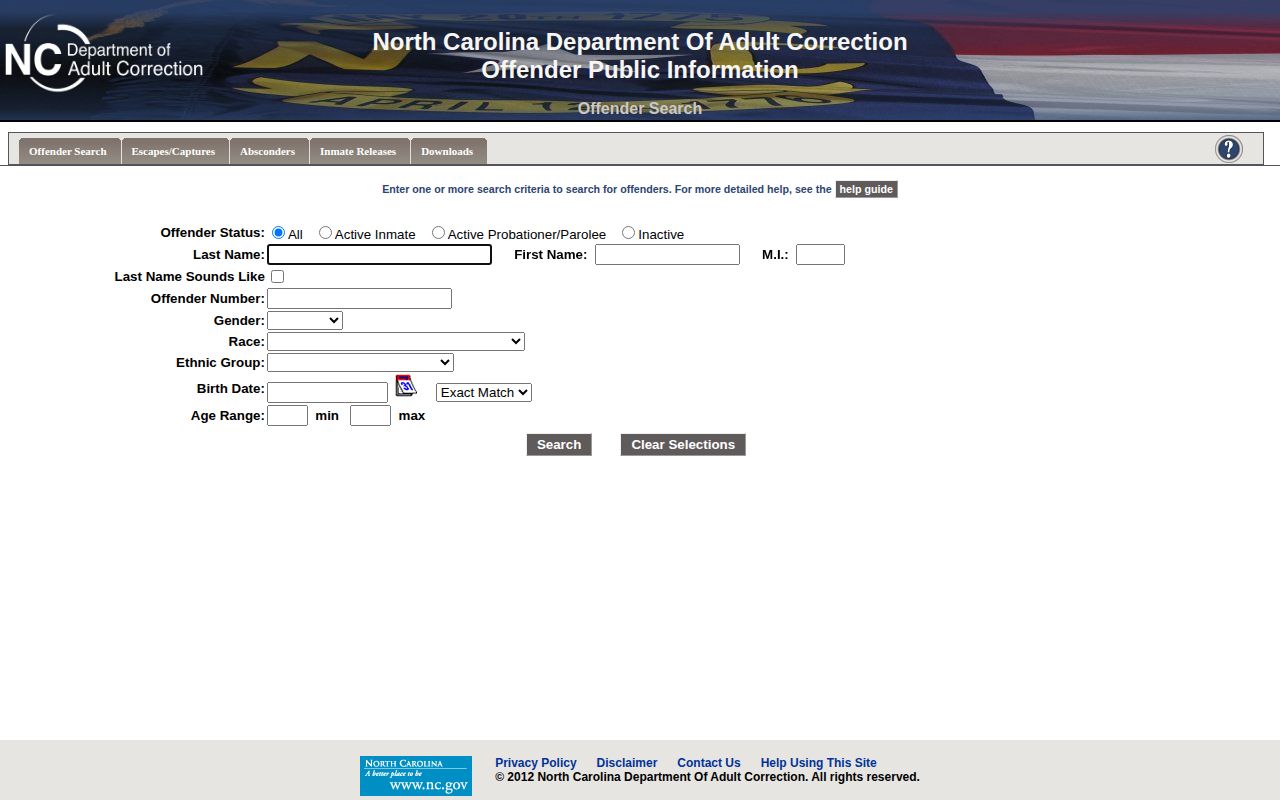
The form helps locate the state record. The matching sentence screen, not the search form alone, is where the exact public date labels and status must be read.
Note: A move from Craven Correctional Institution to another NCDAC prison is a transfer, even if the former location no longer appears.
Craven Release Dates and Earned Time
Modern North Carolina Structured Sentencing requires a person to serve the judicially imposed minimum term. G.S. 15A-1340.13(d) governs that minimum-term rule. Earned time can reduce the maximum toward the minimum, but it cannot reduce the sentence below the minimum. The maximum also contains statutory space tied to post-release supervision. That is why the projected prison departure and final end of legal supervision are not the same date.
NCDAC policy distinguishes older Good Time and Gain Time from Structured Sentencing Earned Time. Under the policy described in the research, eligible felons may earn up to nine days per month and eligible misdemeanants up to four through qualifying work, programs, and conduct. Credits can be forfeited. Corrected jail credit, discipline, a new court action, or changes to concurrent and consecutive terms can also alter the calculation. “Concurrent” terms run together; “consecutive” terms run one after another.
The official North Carolina projected-release calculation statute shows the governing minimum and maximum framework.
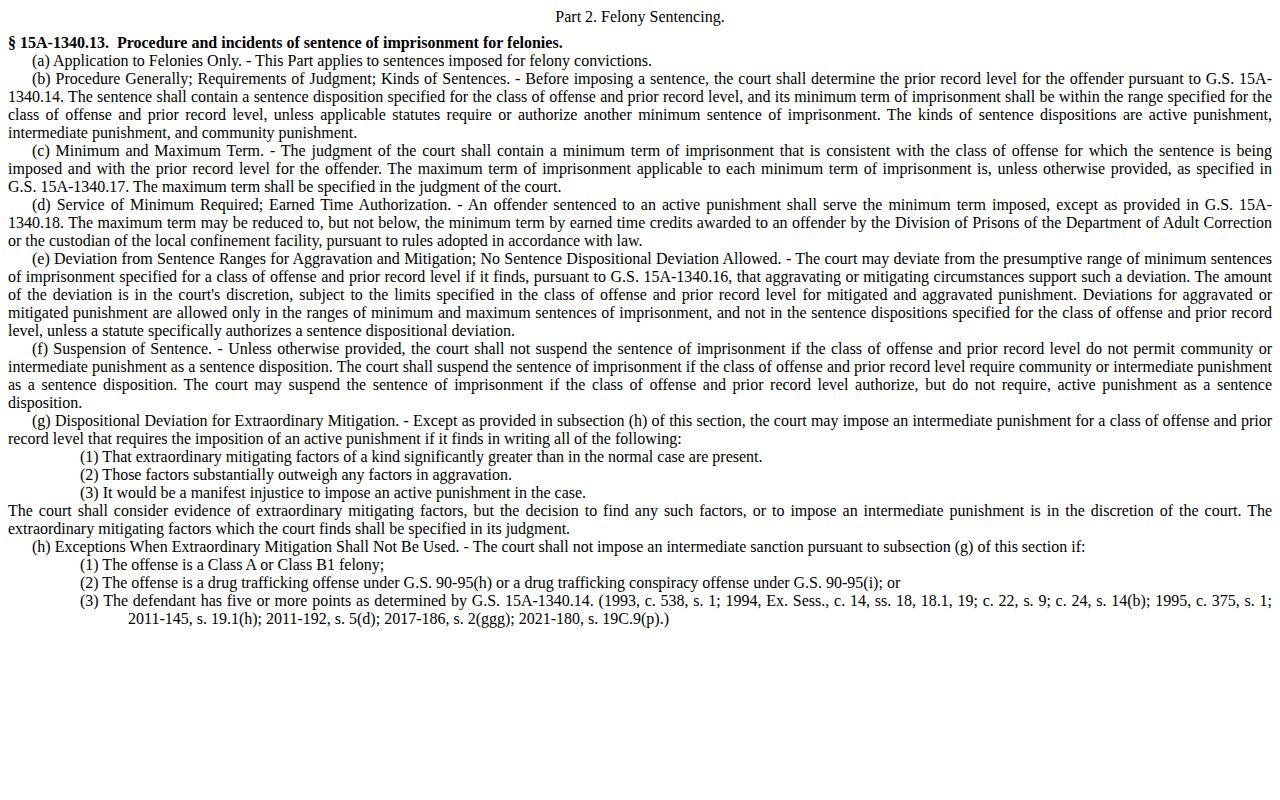
The statute is a source for the rule, not a do-it-yourself calculator. Offense date, punishment type, sentence history, jail credit, credits, and later legal events must be read from the actual record.
NCDAC Combined Records authorizes most state releases. The official procedure requires staff to finish an external-movement screen before departure so no unaudited sentence remains. Meritorious-time approval can even change a Projected Release Date after release approval, which triggers notice to Combined Records. These controls explain why a public projection can move without being unreliable: the final authority depends on the complete record at the time release is processed.
No Craven 85 Percent Rule
North Carolina's rule is not the generic shorthand “serve 85%.” That phrase should be rejected for a Craven County release date lookup. Under Structured Sentencing, the person serves 100 percent of the court's minimum term. Earned time may move the maximum toward the minimum, never below it. Applying an unsupported percentage to the maximum or minimum can create a false date and can ignore the sentence regime that actually controls.
Older cases can follow different rules. Sentences for offenses before October 1, 1994, some DWI matters, and special statutes may involve parole or older good-time structures. Read Punishment Type, offense date, judgment, and sentence history. Parole is a conditional release under the Commission's authority for eligible older or special cases. It should not be inserted into every modern prison calculation.
Post-release supervision also affects how the maximum is structured. G.S. 15A-1368.2 supplies the statutory release calculation for covered structured sentences. The current version and the version controlling the offense must be checked. A public projected date from NCDAC remains safer than a hand calculation because Combined Records applies the full sentence history.
The statute generally places covered Class B1 through E felonies at maximum less twelve months and Class F through I felonies at maximum less nine months, less applicable earned time, with a different five-year structure for specified registrable offenses. Those figures describe the statutory framework, not a guaranteed date for a named person. Amendments, offense dates, and special provisions matter. Use them to understand the NCDAC field, not to replace it.
Why Craven Release Dates Change
A changed projection is not proof that the agency made an error. NCDAC can lawfully update the date as credits, sentence data, or release authority change. A hold may keep the person in custody after one matter ends, while a transfer may end one facility's custody without ending incarceration. Compare the new record with the prior one and describe each event precisely.
| Factor | Possible effect | Best source |
|---|---|---|
| Earned time | Moves the maximum toward, but not below, the minimum | NCDAC sentence detail and policy |
| Credit forfeiture | May move a projected date later | NCDAC Combined Records |
| Corrected jail credit | Changes time credited before state admission | Judgment and NCDAC computation |
| Sentence structure | Concurrent or consecutive terms alter the aggregate calculation | Court judgment and sentence history |
| Court action | Can modify, vacate, or otherwise change legal authority | Craven eCourts record and certified order |
| Hold or detainer | Can lead to another custodian after one release event | Releasing sheet and receiving agency |
| Parole decision | May set conditional release for an eligible older or special sentence | Commission material and NCDAC status |
A detainer is a request or notice tied to another authority's custody interest. It does not mean the listed projected date is fake. It means the end of one sentence may not result in immediate community release. The release or transfer sheet should identify the next custodian when that field is maintained and public.
When Craven Prison Releases Occur
NCDAC's official release procedure adds a practical North Carolina distinction. Ordinary expiration releases favor Monday through Friday from 8 a.m. to 5 p.m. When possible, discretionary-time credit may allow a weekend or holiday expiration to occur on the prior weekday. That practice does not create a universal promise about a particular person or a county-jail exit time.
Scheduled post-release-supervision cases follow a different rule. They must be released on the statutory scheduled date, including weekends and holidays. Post-release supervision means physical prison custody ends while Commission conditions and NCDAC Community Supervision continue. The state policy also permits some eligible people to move near the planned residence before release. A late facility change can therefore be release preparation, not completed departure.
Craven County publishes no general jail release hour, exit door, or holiday routine. Do not apply the prison policy to the Craven County Detention Center. A county sentence must be checked through the judgment, jail credit, and jail record. For a state sentence, use the NCDAC date and status fields, then verify the posted event after the scheduled day.
Confirm Craven Release and Supervision
Near the projected date, reopen NCDAC Offender Public Information. Read the incarceration Service Status and look for the Actual Release Date. Then inspect the distinct probation, parole, or post-release status. An “Active Probationer/Parolee” label can describe a person in the community under supervision, not a person still inside an NCDAC prison. “Inactive” alone does not identify which event ended the record.
Expiration and discharge also differ. Expiration, sometimes called max out or PRD in the official release policy, can mean the prison sentence has been fully served with no parole or post-release reporting. A prison release onto post-release supervision ends physical custody but not the Commission's conditions. Final discharge ends that supervision or other legal control. Read all status sections before describing the result.
For a Craven jail event, contact the detention center at 252-636-6619 and use Sheriff Chip Hughes's office or the county public-record route for an existing release sheet. North Carolina eCourts can supply the bond order, dismissal, judgment, sentence, or probation order that explains legal authority. The court timestamp still should not be substituted for the actual out-processing time.
A pending status alert can be registered through the Craven County VINE inmate check. Treat that alert as corroboration. If NCDAC, the court, and an alert appear to conflict, preserve their separate timestamps and ask each custodian about its own field. The strongest proof combines the responsible custodian's actual release record with the court, supervision, or receiving-system record that explains what followed.
Keep the date label with the result. “Projected,” “actual,” “sentence begin,” and “supervision end” answer different questions. Recording the offender number, sentence number, status, and check time makes a later comparison reliable and reduces the chance of mixing two people or two sentence episodes.